Before the Stories Are Gone
By Monique Norington
Author of This Well Runs Deep
What if I told you that some of your family’s greatest treasures aren’t sitting in a bank account or locked in a safe?
They may be tucked inside an old family Bible, stored in a shoebox, or sitting in a cardboard box in someone’s garage.
I know because it happened to me.
Recently, my uncle passed away. While going through his belongings, a box of family documents was discovered in his garage.

Inside were original birth records and documents I had spent more than twelve years searching for.
Twelve years!
But one of the most remarkable discoveries was a handwritten history of my aunt’s life, recorded in her own handwriting.

Her memories. Her experiences. Her story.
For years, I had searched historical archives and public records, trying to piece together our family’s history. Yet some of the answers had been sitting in my uncle’s garage all along.
It made me wonder: How many of us have family treasures sitting in closets, attics, basements, and garages without realizing their value?
And how many stories disappear simply because no one thought to ask?
Start With a Family Asset Map
Before spending money on genealogy subscriptions or searching historical archives, start with the people already in your life.

In community development, we use asset mapping to identify the knowledge, resources, and relationships within a community. I believe every family should do the same.
Create a simple list of your living relatives and identify what each person may know or possess.
- Who knows the family’s history?
- Who has the old photographs, letters, and documents?
- Who remembers the names of earlier generations?
- Who has the family Bible or handwritten journals?
- Who has already researched the family tree?
- Who knows relatives you haven’t met?
Include names, relationships, contact information, and the family branch each person belongs to. Ask permission before recording or sharing personal details.
Sometimes the missing pieces of our history aren’t lost. We simply don’t know who has them.
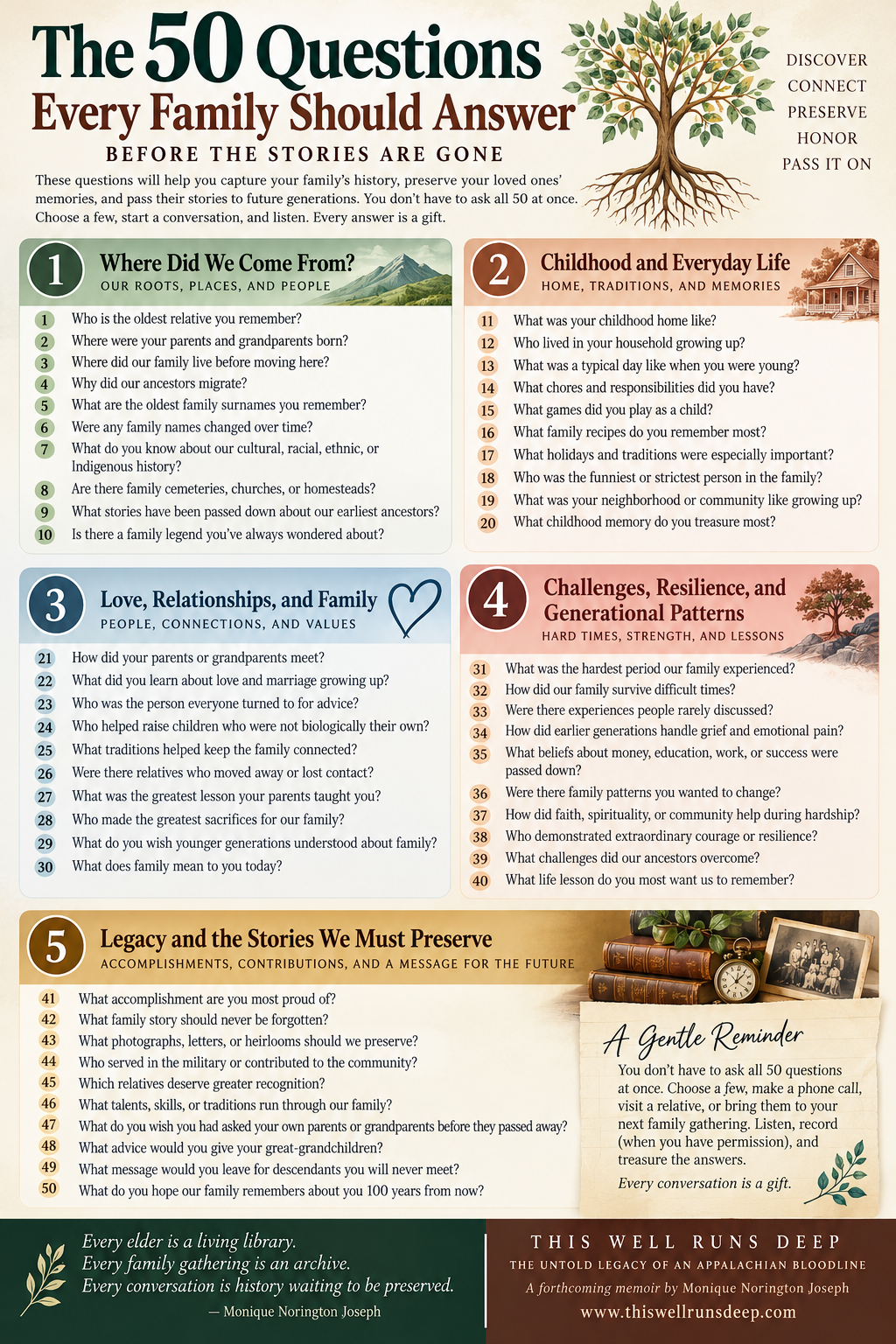
The 50 Questions Every Family Should Answer

You don’t need to ask all fifty questions at once. Choose a few during a family dinner, reunion, or telephone conversation. With permission, record the stories so future generations can hear them, too.
1. Where Did We Come From?
- Who is the oldest relative you remember?
- Where were your parents and grandparents born?
- Where did our family live before moving here?
- Why did our ancestors migrate?
- What are the oldest family surnames you remember?
- Were any family names changed over time?
- What do you know about our cultural or ancestral roots?
- Are there family cemeteries, churches, or homesteads?
- What stories have been passed down about our earliest ancestors?
- Is there a family legend you’ve always wondered about?
2. Childhood and Family Traditions
- What was your childhood home like?
- Who lived in your household growing up?
- What was a typical childhood day like?
- What chores did you have?
- What games did you play?
- What family recipes do you remember?
- Which holidays and traditions were most important?
- Who was the funniest or strictest family member?
- What was your neighborhood like growing up?
- What childhood memory do you treasure most?
3. Love, Relationships, and Family
- How did your parents or grandparents meet?
- What did you learn about love and marriage?
- Who did everyone turn to for advice?
- Who helped raise children in the extended family?
- What traditions kept everyone connected?
- Were there relatives who moved away or lost contact?
- What was the greatest lesson your parents taught you?
- Who made the greatest sacrifices for our family?
- What do you wish younger generations understood?
- What does family mean to you?
4. Challenges, Resilience, and Generational Patterns
Some questions may touch on painful experiences. Allow relatives to share only what feels comfortable.
- What was the hardest period our family experienced?
- How did our family survive difficult times?
- Were there experiences people rarely discussed?
- How did earlier generations handle grief?
- What beliefs about money, education, or work were passed down?
- Were there family patterns you wanted to change?
- How did faith or community help during hardship?
- Who demonstrated extraordinary courage?
- What challenges did our ancestors overcome?
- What life lesson do you most want us to remember?
5. Legacy and the Stories We Must Preserve
- What accomplishment are you most proud of?
- What family story should never be forgotten?
- What photographs, letters, or heirlooms should we preserve?
- Who served in the military or contributed to the community?
- Which relatives deserve greater recognition?
- What talents or traditions run through our family?
- What do you wish you had asked your parents or grandparents?
- What advice would you give your great-grandchildren?
- What message would you leave for descendants you’ll never meet?
- What do you hope our family remembers about you 100 years from now?
Don’t Know Your Family History? Start Here.
If you don’t know much about your relatives, consider taking a genealogy DNA test.
DNA testing can help identify genetic relatives and provide clues about family connections. It’s one of the tools that helped launch my own twelve-year journey of discovery.
But DNA is only a starting point. Combine your results with family conversations, historical records, and careful research. Consider privacy and the possibility of unexpected discoveries before testing.
You can also begin with a birth certificate, an old photograph, a family surname, or a remembered hometown.
One name can lead to another. One conversation can open an entirely new chapter.
Your Family History Challenge
This week, choose five questions and call someone in your family.
Ask about their childhood. Their parents. Their memories.
And before you hang up, ask one final question:
“Is there anything about our family you think I should know that I’ve never asked?”
You might be surprised by the answer.
After twelve years of researching my family, I am still discovering stories and documents that change what I thought I knew.
My uncle’s box reminded me that we don’t always have to travel across the country to uncover our history.
Sometimes we simply need to open a box, make a phone call, or sit down and listen.
Every elder is a living library. Every family gathering is an archive. Every conversation is history waiting to be preserved.
Don’t wait until the stories are gone.
Continue the Journey
This Well Runs Deep: The Untold Legacy of an Appalachian Bloodline chronicles my twelve-year journey of uncovering my family’s history and discovering what flows from one generation to the next.
The book is coming this November!
Join the Legacy List for updates, discoveries, and book release news.
Because your family’s story matters, too.