How family experiences, unspoken grief, and survival patterns can influence generations—and how understanding them can help us make different choices.
By Monique Norington

Have you ever wondered why certain things affect you so deeply?
Why you struggle to trust people who have given you no reason not to?
Why you feel guilty when you rest?
Why you always feel the need to be strong, even when you’re exhausted?
Or why certain patterns seem to repeat themselves in your family, generation after generation?
Sometimes, the answers aren’t found entirely in our own experiences.
Sometimes, we have to look at the lives of the people who came before us.
You may be carrying a pain that didn’t begin with you.
And you may not even realize it.
What We Inherit Beyond DNA

The other day my daughter was taking photos of our eyes and nose to see if they matched or looked alike. It’s as if she was examining me and our features. When we think about inheritance, we usually think about physical characteristics.
Our mother’s eyes. Our father’s smile. Our grandmother’s hands.
But families pass down much more than physical traits.
We inherit beliefs about money, relationships, marriage, parenting, success, and survival.
We learn how to handle conflict by watching the adults around us.
We learn whether it’s safe to express emotions.
We learn whether love comes with conditions.
We learn what it means to be strong.
And sometimes, without anyone intending it, we learn to carry burdens that were never ours to begin with.
A grandmother who experienced poverty may have taught her children to save everything because she knew what it meant to have nothing.
A grandfather who endured discrimination may have taught his children to remain quiet, work twice as hard, and never challenge authority.
A mother who experienced abandonment may have struggled to trust others, even those who genuinely loved her.
A father who was never shown affection may have found it difficult to express love to his own children.
These responses may have helped someone survive a difficult chapter of life.
But what happens when the next generation continues living by those same rules, even when their circumstances have changed?
The Stories Our Families Never Told

One of the most fascinating parts of my twelve-year genealogy journey has been discovering how much of my family’s history was never openly discussed.
I’ve spent years searching through birth records, census documents, military records, and historical archives, tracing my ancestors through the Appalachian Mountains of Virginia and Kentucky.
I’ve uncovered stories of extraordinary resilience.
But I’ve also encountered questions.
What did my ancestors experience that they never spoke about?
What losses did they endure?
What sacrifices did they make?
What did they teach their children about surviving in a world that often treated them differently because of their race, gender, or circumstances?
And how much of that thinking continued long after they were gone?
Historical documents can tell us where someone lived, whom they married, and sometimes what they owned.
But they rarely tell us what kept that person awake at night.
They don’t tell us about the heartbreak they carried.
The dreams they abandoned.
Or the fears they passed along without ever putting them into words.
Sometimes silence becomes part of a family’s inheritance.
And when we don’t know the stories behind certain behaviors, we may mistake survival habits for personality traits.
We say things like:
“That’s just how the women in our family are.”
“The men in our family don’t talk about their feelings.”
“We’ve always had to do everything ourselves.”
“Nobody in this family trusts anybody.”
But have we ever stopped to ask why?
When Survival Becomes a Family Tradition
I think about the generations of women who came before me.
Women who lived during times when their choices were limited by circumstances, social expectations, and laws.
Some had to make difficult decisions simply to protect themselves and their children.
Others carried responsibilities that left little room for their own dreams.
Their strength deserves recognition.
But I’ve also come to understand something important.
Not every survival skill needs to become a family tradition.
Being strong does not mean we should never ask for help.
Being independent does not mean we must refuse love or support.
Protecting ourselves does not mean everyone who enters our lives is a threat.
And honoring our ancestors does not require us to repeat every pattern they lived through.
We can appreciate what helped them survive while recognizing that some of those same behaviors may no longer serve us.
That distinction matters.
Because sometimes we become so committed to being strong that we forget we are allowed to live differently.
Can Trauma Really Travel Through Generations?

Researchers and mental health professionals have studied how traumatic experiences can affect families across generations.
This is often called intergenerational trauma.
The idea is not that every painful experience is automatically passed down through DNA. The science surrounding biological and epigenetic transmission in humans is still developing.
What we do know is that family experiences can shape parenting, emotional responses, beliefs, relationships, and the environments in which children grow up.
Children learn from what they see, what they hear, and sometimes what is never explained.
A parent who grew up in an unpredictable home may become overly protective.
Someone raised around financial instability may experience anxiety about money even when their circumstances improve.
A person who rarely witnessed healthy communication may struggle to express their needs in relationships.
None of these patterns means someone is destined to repeat the past.
They simply remind us that understanding our family history can offer valuable insight into our own lives.
And insight gives us an opportunity to make different choices.
You Can Honor Your Family Without Repeating Its Pain
This may be one of the greatest lessons I’ve learned while researching my ancestry.
I can honor the women who came before me without believing I must endure everything they endured.
I can respect their sacrifices without making suffering the measure of my own strength.
I can appreciate the resilience that runs through my family while also making room for peace, joy, vulnerability, and rest.
And I can teach the next generation that love doesn’t have to look like sacrifice all the time.
Sometimes love looks like setting boundaries.
Sometimes it looks like apologizing.
Sometimes it looks like asking for help.
Sometimes it means having a conversation that previous generations were never able to have.
And sometimes healing begins with simply acknowledging that something hurt.
Understanding where a pattern began doesn’t excuse harmful behavior, but it can help us recognize what needs to change.
We don’t have to blame our ancestors to learn from them.
They were human beings doing their best with the knowledge, resources, and choices available to them.
Just as we are today.
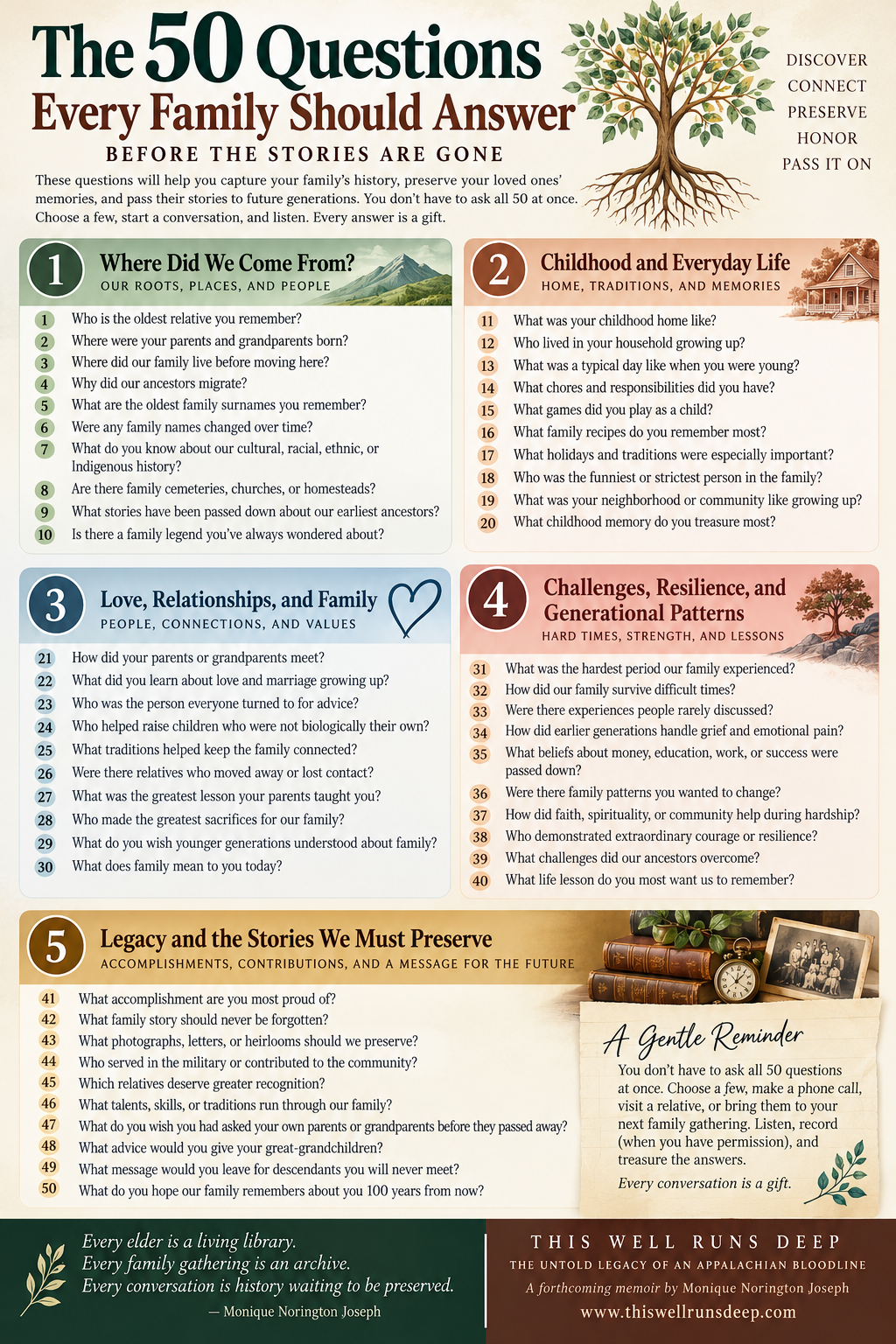
Five Questions Worth Asking Yourself
As you think about your own family’s history, consider these questions:
- What beliefs about love, money, relationships, or success did I learn growing up? Do those beliefs still serve me?
- What emotions were acceptable in my family? Were we encouraged to express sadness, fear, and disappointment, or expected to remain strong?
- What patterns seem to repeat across generations? Consider relationships, communication, parenting, financial habits, and conflict.
- What did my parents or grandparents experience that may have influenced how they raised their children?
- What do I want the next generation to inherit from me—and what do I want to end with me?
You may not have all the answers.
That’s okay.
Sometimes the first step is becoming curious enough to ask the questions.
And if you have older relatives who are willing to share their experiences, talk with them.
Not to judge their choices.
But to understand the world that shaped them.
What Will We Pass On?
When I began researching my family history more than twelve years ago, I thought I was searching for ancestors.
I wanted names, dates, places, and connections.
I wanted to understand the different branches of my family and how they came together.
But somewhere along the way, my search became about something much deeper.
I began thinking about what flows through a family from one generation to the next.
Not just blood.
But faith.
Resilience.
Love.
Fear.
Silence.
Wisdom.
And sometimes pain.
My ancestors left me a history that stretches back more than two centuries. Their lives helped make mine possible.
I cannot change what they experienced.
I cannot rewrite their hardships or give them opportunities they may never have had.
But I can learn from their lives.
I can tell their stories.
And I can be intentional about what I pass on.
Because perhaps the greatest way to honor those who came before us is not simply to remember how they survived.
It’s to give the generations who follow us the opportunity to do more than survive.
To live.
To love.
To feel safe.
To experience joy.
And to know that their lives can be different.
You may be carrying a pain that didn’t begin with you.
But that doesn’t mean it has to define the rest of your story.
And it certainly doesn’t mean you have to pass it on.
This Well Runs Deep — Coming This November
For more than twelve years, I’ve been uncovering the extraordinary history of my family, tracing eight generations and more than 230 years of stories through the Appalachian Mountains of Virginia and Kentucky.
What began as a search for my ancestors became a journey of understanding the resilience, sacrifices, trauma, faith, and love that can travel through a bloodline.
My forthcoming memoir, This Well Runs Deep: The Untold Legacy of an Appalachian Bloodline, explores those discoveries and what learning about my ancestors’ lives has taught me about my own.
The book is coming this November, and I’d love for you to be part of the journey.
Visit thiswellrunsdeep.com and join my Legacy List to receive updates, behind-the-scenes stories, and the first announcement when the book is released.
Because every family has a story.
And sometimes understanding where we’ve been is the beginning of discovering where we want to go.